The Two-Sentence Spotter Brief: Heavy Lifting Without the Guesswork
The safety bar on a Ferris wheel isn't there because the ride operator expects you to leap out at the top. It's there because everyone agrees on the terms before the wheel moves: you stay in, the bar stays down, the ride does its job. That's not distrust. That's a shared plan.
Heavy lifting works the same way. A spotter isn't a stranger you blindly trust with your ribcage, and asking for one isn't an admission that you're about to fail. It's a short, clear agreement: here's what I'm doing, here's what I need from you, here's when to step in. Two sentences can cover it. The rest is just showing up prepared.
The Safety Bar Mindset
Most bad spotting stories start with silence. The lifter assumes the spotter knows the plan. The spotter assumes the lifter wants a full hero lift at the first sign of a slow rep. Both people are trying to help. Neither one said what "help" means.
Treat the spotter like a safety bar: not a rescue crew, not a cheerleader, just a person holding a specific role until the set is over. Your job is to define the role before you touch the bar. Their job is to follow it. That's the whole principle.
The Two-Sentence Brief
Keep it short enough that you'll actually do it every time. Something like:
"I'm doing five reps at this weight. I want a lift-off, then hands off unless I say 'take it' or the bar stalls for a second — then help me rack it."
That's it. Two sentences. It covers the handoff, the level of help, and the signal. You can adapt the details, but don't skip the categories:
- What you're doing. Exercise, rep target, and whether it's a max attempt or a standard working set.
- What you want at the start. Lift-off, no lift-off, or a walk-out assist.
- When to intervene. A spoken cue, a stall, or a full fail.
- What happens at the end. Rack it together or hands off.
Say it while you're chalking up, not while you're under the bar with your shoulders pinned. The pre-lift window is the only time you get to be completely clear without wasting a rep.
Bench: The Handoff Is a Conversation
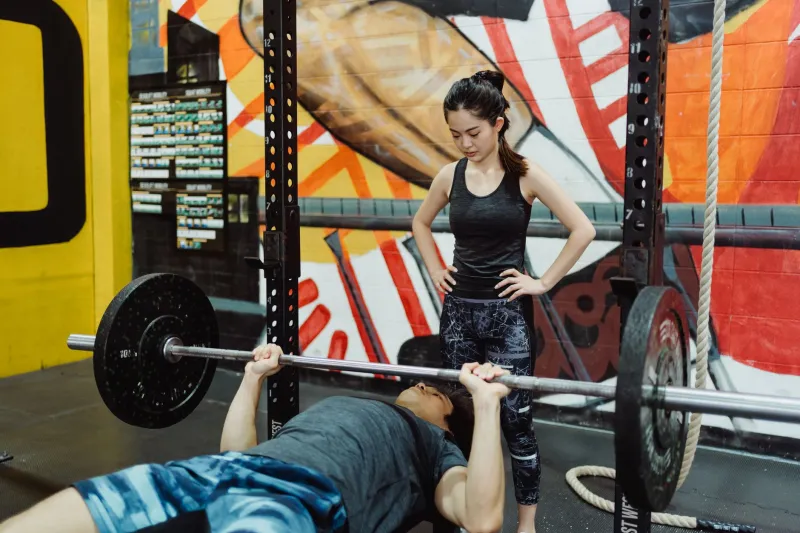
The bench press is where spotting gets weird, because the handoff and the spot are two different jobs. Plenty of people do one and think they're doing the other.
Be specific. "Can you give me a lift-off?" is not the same as "Can you spot me?" A lift-off means they help unrack the bar and then get their hands out of your line of sight. A spot means they're watching the bar path and ready to assist if the rep goes sideways. Ask for both if you want both. If you only want the unrack, say so.
Also tell them where to stand. For bench, that's usually behind your head, hands near the bar but not on it, eyes on the bar. If they're hovering over your face like a nervous parent, you'll rush the rep just to get them out of your airspace. A good spotter is close enough to help and far enough to let you work.
Squat: Walk-Out, Not Guesswork
Squats are different because the rack is usually right there, and a spotter behind you can either be a useful backup or a traffic cone with hands. The brief matters more than the body position.
If you want a spot, say what kind: a hands-on spot for a true max attempt, or just a "stay close and catch me if I dump it" presence for a heavy working set. Tell them you'll walk the bar out yourself unless you ask otherwise. Tell them you'll rerack on your own unless you say the word. The worst squat spot is the one where the helper grabs the bar mid-rep because they misread a grind as a fail. A grind is not a fail. Say that out loud if you have to.
If the rack has safeties — and most US gym racks do — use them. A squat rack with the pins set just below your bottom position is a partner that never guesses. More on that in a minute.
Dumbbell Presses: The Spotter's Job Is Not Your Job
Dumbbell pressing is the wild card. People ask for a spot and then expect the spotter to do a solo cable routine with two dumbbells and a prayer. That's not a spot. That's a juggling act.
The useful version of a dumbbell spot is a lift-off and a watchful presence. Ask for help getting the dumbbells into position, then have the spotter stay close enough to guide your elbows if a rep stalls. You're still controlling the weight. If you're going for a true max dumbbell press, consider a spotter on each side or skip the hero set entirely. One person trying to catch two dumbbells is how wrists and toes get hurt.
Red Flags: When to Pick the Rack Instead
Not every volunteer is a good spot. Watch for these before you hand over your set:
- They're on their phone. A spotter who's scrolling is a spectator with a front-row seat.
- They start grabbing the bar early. If they can't let a rep grind, they'll rob you of the set and maybe tweak your shoulder doing it.
- They won't listen to the brief. If they wave off your instructions with "I got you, bro," they don't got you.
- They're clearly unfamiliar with the lift. Enthusiasm is great. Technique matters more when there's a loaded bar over your throat.
- They're mid-set themselves. A tired spotter is a delayed spotter. Wait for someone who's fresh enough to actually help.
You're allowed to say, "Thanks, I'm actually going to use the safeties today." That's not rude. That's risk management.
Rack Safeties Are Not an Insult
A power rack with the pins set correctly is the most reliable spotter in the building. It doesn't get distracted, it doesn't misread a grind, and it shows up every single time. Learn to set the safeties just below your lowest point on bench and squat. Test the height with an empty bar. Then train heavy with a clear conscience.
Use a human spotter when you want a lift-off, when you're testing a true max, or when the exercise doesn't play nice with pins. Use the rack when you want a guaranteed catch and zero conversation. Neither choice is tougher than the other. Both are smarter than hoping a stranger reads your mind.
Lock the Bar, Then Lift
The Ferris wheel doesn't ask you to trust the operator's vibes. It asks you to sit down, pull the bar across, and ride. Your heavy sets deserve the same clarity. Say what you need. Confirm the signal. Pick the rack when it's the better partner. Then load the bar and get after it — with a plan instead of a prayer.