The Climb Is the Point: What a Ferris Wheel Teaches You About Plateaus
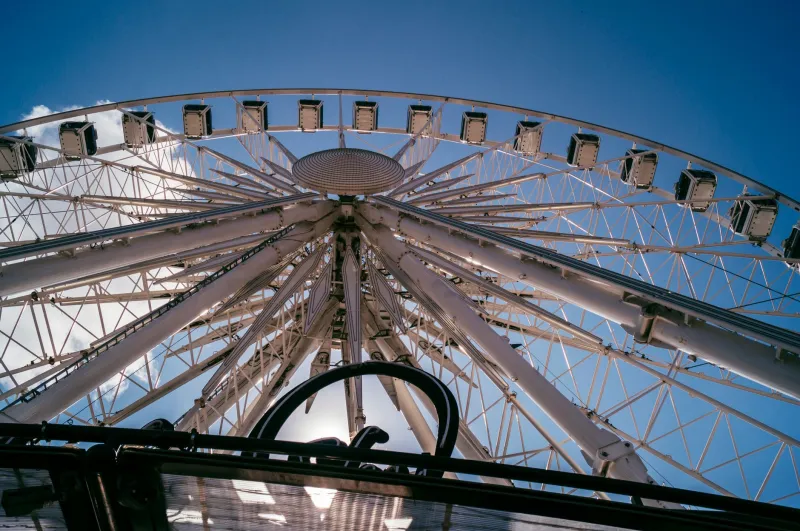
There's a reason we named this place Gym Ferris. A Ferris wheel is one of the most honest machines ever built. It doesn't promise a rocket launch. It promises a ride — slow in some sections, fast in others, and the whole thing only works because it goes all the way around. Every time. That's the mindset we want you walking onto our floor with: not chasing a highlight reel, but committing to the full rotation.
The Physics of a Slow Climb
Think about what's actually happening when a Ferris wheel lifts you. Gravity is working against the car the entire ascent. Every inch upward costs energy. There's no momentum to coast on — the motor just grinds, steadily, unglamorously, until you reach the top.
Sound familiar? It should. That's your first eight weeks of a strength program. That's mile three of your first 5K. That's the moment you're staring down a set of squats at a weight that used to be your working max. The climb doesn't feel like progress because progress at that stage is measured in inches, not highlights. But biomechanically, everything that matters is happening: your connective tissue adapting, your nervous system learning to recruit muscle fibers more efficiently, your work capacity quietly stacking like bricks.
The climb is where the adaptation is purchased. The view at the top is just the receipt.
The Top Isn't a Trophy — It's a Checkpoint
Here's where most people quit, and it's not during the hard part. It's at the plateau.
You've been training consistently for months. Your lifts moved, your waistline shifted, your energy climbed. Then — nothing. The scale freezes. Your bench press sticks at the same number for six weeks. And because our culture sells fitness as a straight upward line, that stall feels like failure.
It's not. It's the top of the wheel. And on a real Ferris wheel, the top is where the car pauses before the descent begins. That pause is engineered into the ride.
Plateaus are your body's way of saying: I've adapted to everything you've asked of me. Show me something new. That's not a wall. That's an invitation. A deload week. A change in rep ranges. A new movement pattern. More sleep. More protein. The plateau is where smart lifters audit their recovery and their programming — and where impatient ones abandon a program that was one adjustment away from working.
Fast Drops Are Not Losses
Now the part nobody tells you: after the top, the wheel descends, and it descends faster than it climbed. On a Ferris wheel, that's the fun part. In training, that's the cut phase after a building phase. That's the week your squat suddenly feels weightless after months of grinding. That's the moment all that slow adaptation cashes out at once.
But here's the catch — the drop only feels good if you stayed in the car. If you bailed at the top because the view stopped changing, you never get the descent. You never get the compounding payoff where weeks of invisible work suddenly become visible.
We've watched it a hundred times on our floor: the member who pushed through a twelve-week plateau and then dropped two belt holes in a month. The drop was earned by the climb. You can't have one without the other.
Stay Strapped In
So how do you actually stay on the ride? Three things we tell every member at Gym Ferris:
Track the rotation, not the view. Judge your progress in 12-week blocks, not daily weigh-ins. The wheel doesn't evaluate itself every quarter-turn, and neither should you.
Expect the pause. Write it into your plan. When a plateau arrives on schedule instead of as a surprise, it loses its power to rattle you.
Ride with people. A solo rider quits at the top. A full car keeps going because nobody wants to be the one who asks to get off. That's what group training and a real gym community are for.
Round and Round, But Never in Place
The best part of the metaphor? The wheel never actually repeats itself. You come back around to the same point — but you're a different person in the car. The version of you who steps into the gym next January has already survived every climb this year threw at you.
That's the long game. Not a straight line up, but a full rotation, over and over, each pass stronger than the last.
So the next time your progress stalls and your brain whispers what's the point — remember the wheel. The top isn't the destination. Staying on the ride is.
Ride the grind. Own your strength.